
What Is a Tube Flaring Tool? A Complete Guide for HVAC Copper Tube Installation
What Is a Tube Flaring Tool? A Complete Guide for HVAC Copper Tube Installation
Introduction
In HVAC and refrigeration systems, reliable tubing connections are essential for maintaining system pressure and preventing refrigerant leakage. While brazing is commonly used in many applications, flare connections remain one of the most practical solutions for service work, split air conditioning systems, refrigeration equipment, and field installations.
Creating a reliable flare connection requires more than simply expanding the end of a copper tube. The quality of the flare directly affects sealing performance, installation efficiency, and long-term system reliability. This is where a tube flaring tool plays an important role.
Whether you are an HVAC technician, a tool distributor, or an OEM buyer looking for professional refrigeration tools, understanding how tube flaring works helps you choose the right equipment and improve installation quality.
H2 What Is a Tube Flaring Tool?
A tube flaring tool is a hand tool designed to form the end of a metal tube into a conical flare. This flared end fits against a matching flare fitting, creating a strong mechanical seal without welding or brazing.
In HVAC applications, the most common standard is the 45-degree flare, which is widely used for refrigerant piping made from soft copper tubing.
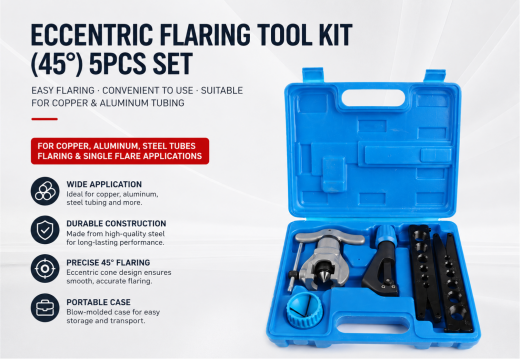
A standard tube flaring tool kit generally includes:
- Flaring bar
- Compression yoke
- Hardened flaring cone
- Multiple tubing size openings
Some professional kits also include swaging adapters for expanding copper tubing.
Related Product
→ Tube Flaring Tool Kits
Precision Eccentric Flaring Tool Kit | Metric & SAE
H2 Why Are Flare Connections Widely Used in HVAC Systems?
Compared with soldered or brazed joints, flare connections offer several practical advantages.
They require no open flame during installation, making them suitable for locations where brazing is inconvenient or unsafe.
Properly made flare connections also simplify maintenance because fittings can be disconnected and reassembled when servicing equipment.
Typical applications include:
- Split air conditioners
- Refrigeration systems
- Heat pumps
- Commercial cooling equipment
- Refrigerant charging lines
Because of these advantages, flare fittings remain one of the most widely used connection methods in residential and light commercial HVAC systems.
H2 Which Materials Can Be Flared?
Although the term "tube flaring" is often associated with copper tubing, several materials can be flared depending on their mechanical properties.
Soft Copper Tube
Soft annealed copper tubing is the most common material used in refrigeration installation. It forms smooth flares with minimal effort and provides excellent sealing performance.
Aluminum Tube
Aluminum tubing can also be flared using appropriate tools, although additional care is required to avoid deformation.
Steel Tube
Some heavy-duty flaring tools are capable of working with thin-wall steel tubing, although greater forming force is required compared with copper.
Selecting the correct tool for the tubing material helps improve flare quality and extends tool life.
H2 How Does a Tube Flaring Tool Work?
The operating principle is relatively simple.
The tubing is first secured inside the flaring bar. The compression yoke then pushes a precision-machined cone into the tube opening.
As pressure increases, the tube end gradually expands into the required flare angle.
Modern eccentric flaring tools improve this process by using an eccentric rolling action instead of direct compression. This helps produce a smoother flare surface while reducing the likelihood of cracks.
If you would like to learn the complete operating procedure, see:
How to Use a Tube Flaring Tool Correctly
H2 Common Applications of Tube Flaring Tools
Tube flaring tools are widely used across several industries.
The most common applications include:
- Air conditioning installation
- Refrigeration maintenance
- Commercial refrigeration equipment
- Automotive air conditioning
- Hydraulic pipe connections
- Gas piping systems (where applicable)
Different industries may use different flare angles. HVAC systems typically use 45-degree flares, while certain hydraulic and automotive applications use 37-degree flares.
A detailed comparison is available in our article:
45° vs 37° Flaring Tool: What's the Difference?
H2 Common Problems During Tube Flaring
Even experienced installers occasionally encounter problems.
Typical issues include:
Cracked Flares
Usually caused by excessive force or work-hardened copper tubing.
Uneven Flare Surface
Often results from improper tube positioning or worn tooling.
Refrigerant Leakage
Typically caused by damaged flare surfaces, incorrect flare angle, or contamination.
A complete troubleshooting guide can be found in:
Common Tube Flaring Problems and How to Fix Them
H2 Choosing the Right Tube Flaring Tool
Selecting the right flaring tool depends on several factors rather than price alone.
Professional buyers usually consider:
- Supported tubing sizes
- Copper, aluminum, or steel compatibility
- Accuracy of the flaring cone
- Durability of the yoke
- Surface hardness
- Replacement parts availability
- OEM customization options
For distributors and private label brands, consistent manufacturing quality is often more important than simply offering the lowest price.
H2 Related Tools Used Together
Tube flaring is only one step in copper tube installation.
Professional technicians usually combine several tools during installation.
These include:
Copper Tube Cutter
Used to create clean and square cuts before flaring.
→ Copper Tubing Cutters
Large Tubing Cutter Pipe Cutter 168mm
Pipe & Tube Bender
Used after flaring to route copper tubing without collapsing the pipe.
→ Pipe & Tube Benders
Heavy-Duty Manual Tube Bender 5mm-22mm
Together, these tools help ensure efficient installation and reliable pipe connections.
H2 Conclusion
A tube flaring tool is one of the most important hand tools used in HVAC and refrigeration installation. It allows technicians to create secure mechanical connections that are easy to assemble, inspect, and service.
Understanding the flaring process, selecting the correct flare angle, and using the appropriate tools all contribute to better installation quality and fewer service issues over time.
For distributors, wholesalers, and OEM brands, understanding these technical fundamentals also helps when evaluating different tool manufacturers and product specifications.
Frequently Asked Questions
What is a tube flaring tool used for?
It is used to form a flare at the end of copper, aluminum, or certain steel tubes so they can be connected with flare fittings.
What is the standard flare angle for HVAC systems?
Most HVAC and refrigeration systems use a 45-degree flare.
Can steel tubing be flared?
Yes, thin-wall steel tubing can be flared using suitable heavy-duty flaring tools, although it requires more force than copper.
What tools are commonly used together with a flaring tool?
Tube cutters, deburring tools, pipe benders, and swaging tools are commonly used during copper tube installation.


 What Is a Tube Flaring Tool? A Complete Guide for HVAC Copper Tube Installation
 Wholesale OEM Tube Flaring Tool Kits for HVAC Distributors | Small MOQ & Private Label Solutions
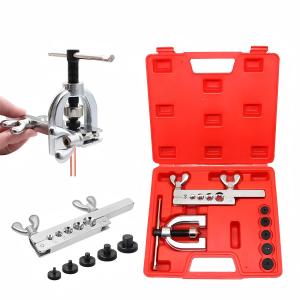 How Small Auto Repair Shops Can Save $2,000+ Per Year Using the Right 8-Piece Brake Line Flaring Tool Kit
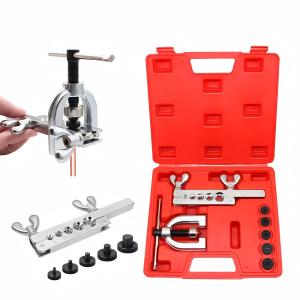 Best 8-Piece Brake Line Flaring Tool Kit for Small Auto Repair Shops 2026 – Wholesale Guide